TL;DR
Scaling creative output without scaling chaos requires infrastructure, not just more people. Below are the six core components of a creative operations framework, each with specific tool recommendations, downloadable templates and an honest look at where teams get stuck. Plus a phased build out from minimum viable creative ops to full maturity, so you can start small and grow into the system instead of trying to build everything at once.
If your creative team is producing more work than ever but missing more deadlines than ever, the issue isn't talent; it's infrastructure. You're running a growing creative operation on ad hoc processes, scattered briefs and tribal knowledge.
At some point, that breaks.
For most enterprise marketing teams, that breaking point has already happened.
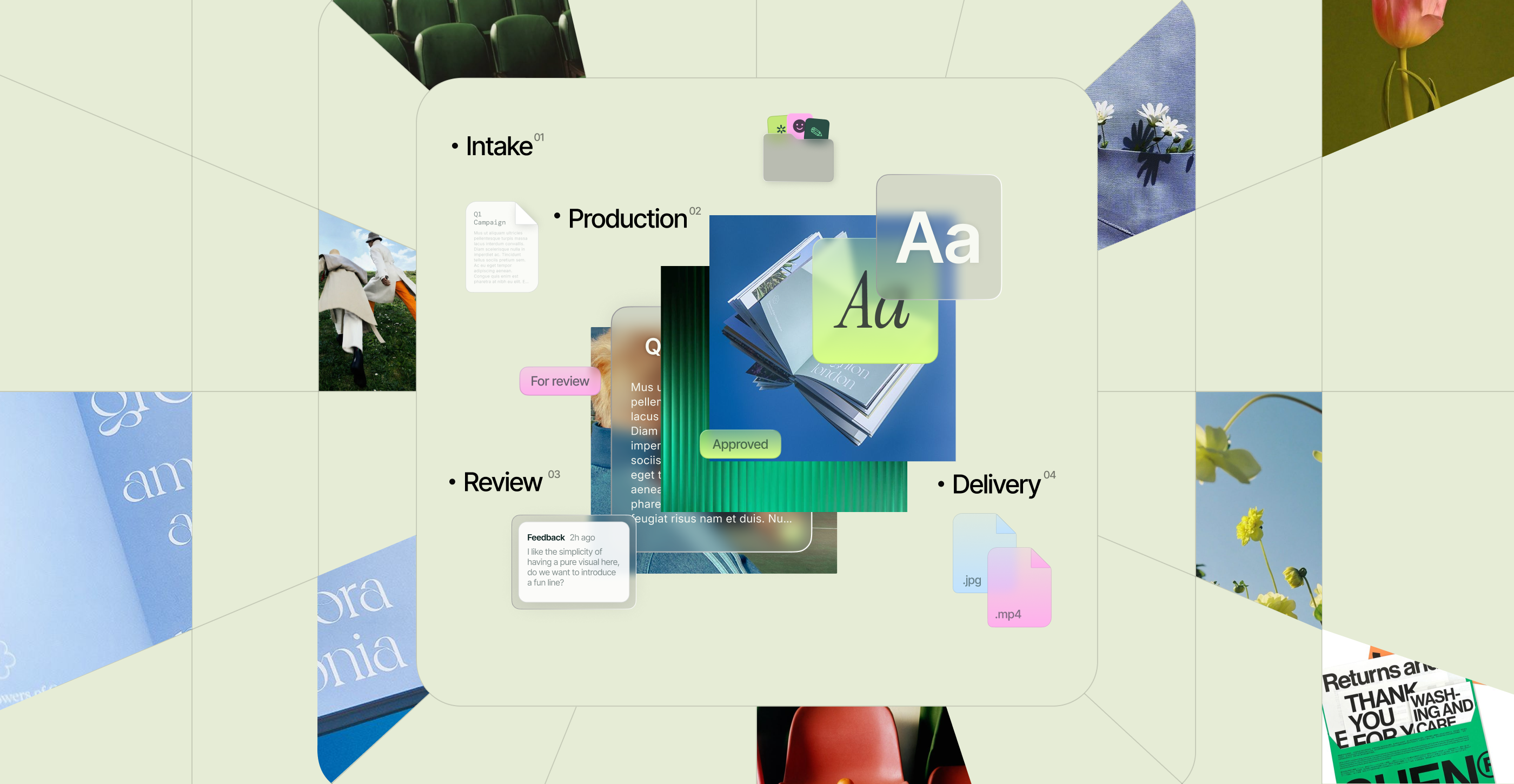
Creative operations is the strategic infrastructure that governs how creative work gets requested, produced, approved and delivered at scale.
Creative operations goes beyond project management. It's the system design layer that sits underneath your creative output, which is the reason one organization can deliver 200 assets a month without breaking a sweat while another struggles with 30.
This blog is a practical framework for building creative operations from scratch, with specific tool recommendations, templates you can use immediately and an honest assessment of where most teams get stuck.
The most effective creative operations framework
Most creative operations problems trace back to the same root causes: unclear ownership, inconsistent processes,and no shared standard for what good looks like. A creative operations framework addresses all of these.
It's the system that defines how creative work moves through your organization, who owns each stage and what "done well" means.
Traditional creative ops frameworks stopped at project management, which included tracking timelines, managing workloads, moving deliverables through a pipeline.
That's table stakes now. Modern creative operations integrate brand intelligence, AI-augmented production workflows and data-driven performance optimization into the core infrastructure.
If your creative ops framework doesn't account for how AI and human creative work intersect, you're building for 2020, not for today and neither for the future.
Do you actually need creative operations?
Not every team does, at least not formally. If you're a team of five producing 10 assets a month for a single brand, you can probably coordinate informally. But if you're nodding along to any of the scenarios below, you've already outgrown informal coordination.
Score yourself honestly. If you answer "yes" to three or more of these, you need creative operations infrastructure, not more people working harder.
Requests arrive through Slack, email and hallway conversations. There's no single intake point. Work gets lost. Nobody has a complete picture of what's in the pipeline.Your team is constantly firefighting. Designers and copywriters spend more time triaging urgent requests and chasing stakeholders for information than they spend creating. Your best creative talent is doing project management.
You can't answer "how many projects can we deliver this quarter?" with data. Capacity planning is guesswork. Hiring decisions are reactive. You don't know if you're over or underutilized until something breaks.
Brand consistency degrades as volume increases. Different designers interpret guidelines differently. Assets look disjointed across channels. Every new team member or agency partner means another round of "that's not how we use our logo."
Approval cycles are unpredictable. Feedback arrives late, in different formats, from multiple stakeholders who haven't seen each other's comments. Projects stall in revision loops. Nobody owns moving work forward.
Teams recreate assets that already exist. There's no searchable creative library. Brand assets live on individual hard drives and scattered cloud folders. Nobody knows if the banner from Q3 was ever finalized.
You're supporting multiple brands, products, or regions. Complexity compounds fast when you're managing consistency across entities, each with their own guidelines and stakeholders.
Stakeholders across departments all request creative work. Sales, product, customer success and marketing all need assets. Without intake governance, everything is urgent and nothing is prioritized.
Leadership asks for creative performance data you don't have. How long does a typical project take? What's the average number of revision rounds? What's the cost per asset? If you're shrugging, creative ops will give you the answers.
Your team has grown but your processes haven't. What worked at 3 people doesn't work at 15. The informal systems that got you here are now the bottleneck.
If you scored 3+: You need creative operations infrastructure. Keep reading, because the framework below gives you a practical build plan.
If you scored 1-2: You're approaching the tipping point. Start with the "minimum viable creative ops" section below to build lightweight foundations before things break.
If you scored 0: You're either at a very early stage or already running solid creative ops. Either way, the framework below is useful as a maturity benchmark.
The 6 core components of a creative operations framework
Each of those 5 questions maps to a core component of the framework. The sections below break down how to build each one, with specific tools, practical steps and an honest look at where most teams get stuck.
<h4>1. Creative intake and request management<h4/>
Every creative operations problem starts with a bad brief. If your team consistently produces work that misses the mark, the issue is almost never creative talent; it's the quality of information they received at the start.
What enterprise-grade intake looks like in practice
Centralized request submission. One entry point for all creative requests, no exceptions. Most enterprise teams use Asana, Monday.com, or Workfront for this, with a structured intake form that routes requests automatically based on project type, urgency and requesting department. Jira works for teams that are already engineering-heavy, though it lacks native creative review features. Airtable and Notion are viable for smaller teams that want flexibility over structure.
Get solutions to enterprise design challenges
Struggling to deliver creative at scale? Check out these resources to find a better way.
Creative operations best practices
Getting the infrastructure right is the foundation. But the teams that actually get leverage from creative operations share a set of habits that go beyond having the right tools and processes in place. These are the things that separate a function that runs well from one that compounds its value over time.
Treat creative ops as strategy, not overhead. The best ops leaders sit at the table with marketing leadership, contribute to campaign planning and forecast creative capacity as a business planning input. If your creative ops function is treated as a service desk that takes tickets, it will never reach its potential.
The failure mode: ops becomes reactive rather than predictive and the team is perpetually behind instead of ahead.Design for humans, not perfection. Complex workflows with 15 approval stages look rigorous on paper but collapse under real-world pressure. People will route around systems they perceive as bureaucratic. Build the simplest workflow that maintains quality, then add complexity only where data shows it's needed.
The failure mode: teams abandon the system entirely because it's too cumbersome and you're back to ad hoc processes.
The failure mode: teams abandon the system entirely because it's too cumbersome and you're back to ad hoc processes.
Embed brand consistency into tools, not documents. If following brand guidelines requires opening a separate PDF and manually cross-referencing, your designers will improvise. Put guidelines inside Figma as components and styles. Use your DAM to surface approved assets contextually. Make the compliant path the easiest path.
The failure mode: beautiful brand guidelines that nobody uses because they're not accessible at the moment of creation.
Co-founder & CTO
CTO and co-founder of Ignious Studio. I build scalable digital products and write about design systems, web performance, and growth strategy for ambitious brands.
You might also like
The Complete Guide to UI/UX Design for SaaS Products in 2025
Everything a SaaS founder or product team needs to know about UI/UX design — from wireframing to design systems, accessibility, and measuring design ROI.
Mobile-First UI Design: Why It's Not Optional Anymore
Over 60% of global web traffic comes from mobile devices. Here's how to design SaaS interfaces that work perfectly on small screens — without sacrificing desktop power.
Design Tokens: How to Build a Scalable Design System from Scratch
Design tokens are the atomic foundation of every great design system. Learn how to structure tokens for color, typography, spacing, and motion — and sync them between Figma and code.